
La manière dont les gens communiquent lors des appels professionnels évolue rapidement. Les équipes ne comptent plus uniquement sur la prise de notes manuelle ou leur mémoire pour suivre le rythme effréné des discussions. L'IA intégrée aux réunions s'est imposée comme un système d'aide précieux qui aide les participants à rester organisés, à saisir les points clés et à comprendre plus clairement les conversations. Elle devient un élément central de la collaboration au sein des équipes modernes et joue un rôle important dans l'amélioration de la qualité des décisions prises après la fin d'un appel.
Cet article explique ce qu'est l'IA en réunion, comment elle fonctionne et pourquoi elle est importante. Il souligne également comment des outils tels que Remi8 améliorent le flux de travail qui suit une réunion en aidant les utilisateurs à stocker, mémoriser et récupérer des informations importantes avec clarté.
Comprendre l'IA pendant les réunions
L'IA pendant les réunions fait référence à des systèmes intelligents qui assistent les participants pendant les appels vidéo ou audio en direct. Ces systèmes analysent les conversations en temps réel, aidant les utilisateurs à saisir des informations qui seraient normalement perdues ou oubliées. L'objectif est de réduire les efforts manuels et d'aider les équipes à rester concentrées sur la conversation au lieu de se précipiter pour prendre des notes.
Fonctionnalités courantes de l'IA pendant les réunions
- Transcription en temps réel
- Identification des intervenants
- Détection des actions à mener
- Suggestions de suivi
- Répartition des sujets
- Résumés des réunions
- Informations sur les sentiments et l'engagement
Ces fonctionnalités permettent aux participants de revoir la réunion après coup sans perdre le fil du contexte. Elles réduisent également le besoin de multitâche, qui conduit souvent à des notes incomplètes ou à des malentendus.
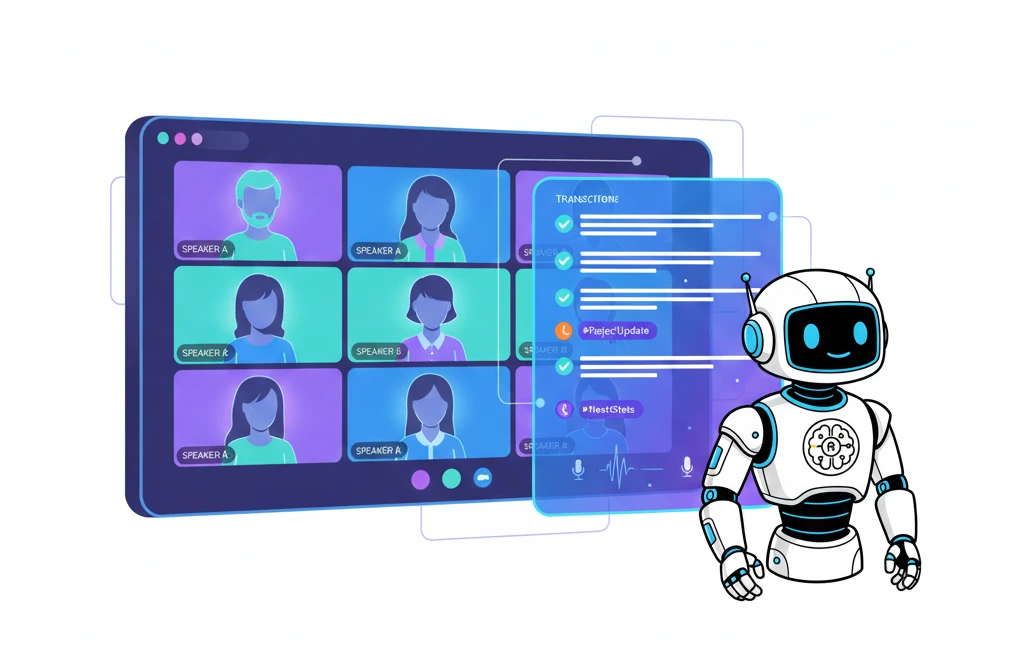
Comment fonctionne l'IA pendant les réunions en coulisses ?
L'IA pendant les réunions utilise plusieurs couches de technologie pour comprendre ce qui est discuté. Elle écoute, interprète et structure les informations afin qu'elles puissent être examinées ultérieurement. Voici une description simple de son fonctionnement.
1. Reconnaissance vocale
Le système convertit les mots prononcés en texte avec une grande précision. C'est la base de tout outil de réunion basé sur l'IA.
2. Compréhension du langage naturel
L'IA analyse les phrases pour identifier leur sens, leur contexte et leurs relations. Cela l'aide à détecter les sujets, les questions et les décisions.
3. Extraction des tâches
Les outils de réunion modernes sont conçus pour détecter les engagements tels que « Je vais envoyer le rapport » ou « Finissons cela avant vendredi ». Les actions à entreprendre sont ensuite présentées clairement à l'utilisateur.
4. Génération de résumés
L'IA organise la conversation en sections structurées telles que les points clés, les décisions, les défis et les prochaines étapes.
5. Accès après la réunion
Une fois la réunion terminée, les participants peuvent consulter à tout moment la transcription, les points forts et les informations pertinentes.
Ces étapes transforment une conversation brute en quelque chose que les utilisateurs peuvent réellement exploiter.
Prêt à ne plus jamais oublier ?
Téléchargez notre application


Gratuit pour commencer | Votre deuxième cerveau personnel
Pourquoi l'IA intégrée aux réunions devient-elle courante ?
Les lieux de travail sont plus dispersés, les réunions plus fréquentes et le rythme des communications s'est accéléré. Les équipes ont besoin d'outils pour gérer la surcharge d'informations qui accompagne ces changements.
1. Augmentation du nombre de réunions virtuelles
Le travail à distance et hybride génère plus de conversations en ligne que jamais. Les gens participent souvent à plusieurs réunions chaque jour, ce qui rend difficile de retenir tout ce qui a été discuté.
2. Réduction de la charge cognitive
Les participants peuvent se concentrer sur l'orateur au lieu d'essayer de tout noter. Cela améliore la clarté, l'engagement et la compréhension.
3. Amélioration du suivi
Les mesures à prendre consignées pendant la réunion permettent d'éviter les retards ou les malentendus.
4. Meilleure prise de décision
Des résumés précis permettent aux équipes de revoir les discussions sans risque d'interprétation erronée, ce qui améliore la qualité des décisions.
5. Mémoire organisationnelle
Les informations enregistrées font partie intégrante de la base de connaissances à long terme d'une équipe.
Ces avantages expliquent pourquoi l'IA en réunion est de plus en plus adoptée par les entreprises technologiques, les agences, les start-ups et les équipes travaillant principalement à distance.
Qui tire le meilleur parti de l'IA pendant les réunions ?
De nombreux groupes tirent profit de cette technologie, mais certains en dépendent davantage que d'autres.
1. Les chefs de projet
Les réunions permettent souvent de définir les calendriers et les responsabilités. Les résumés générés par l'IA aident les responsables à suivre facilement les livrables.
2. Les équipes commerciales
Les appels commerciaux contiennent des objections, des exigences et des engagements. L'IA les enregistre clairement pour référence future.
3. Les équipes d'assistance à la clientèle
L'IA aide à documenter les problèmes, les résolutions et les commentaires importants.
4. Fondateurs et cadres dirigeants
Les dirigeants peuvent consulter les résumés des réunions qu'ils ont manquées ou récapituler les discussions sans avoir à réécouter de longs enregistrements.
5. Étudiants et enseignants
Les cours, les conférences en ligne et les discussions de groupe deviennent plus faciles à revoir et à revisiter.
L'IA pendant les réunions continue de se développer car elle est utile à de nombreux secteurs et rôles.
Limites de l'IA pendant les réunions
Même si cette technologie est puissante, elle n'est pas parfaite. Elle présente certaines limites que les utilisateurs doivent comprendre.
- Les bruits de fond peuvent réduire la précision de la transcription.
- Les accents prononcés ou un son imprécis peuvent entraînerdes interprétations erronées.
- Les discussions très techniques peuvent nécessiter des corrections manuelles.
- Les conversations sensibles peuvent soulever des questions de confidentialité.
- L'IA ne peut pas toujours interpréter les nuances émotionnelles ou le contexte caché.
Ces limites montrent que l'IA utilisée pendant les réunions est un outil qui ne remplace pas la compréhension humaine.
Quelle est la place de Remi8 dans tout cela ?
L'IA intégrée à la réunion gère tout ce qui se passe pendant l'appel, mais elle ne gère pas le reste de votre vie numérique. C'est là que Remi8 entre en jeu. Remi8 est conçu pour être votre système de mémoire à long terme. Il aide les utilisateurs à se souvenir de ce qu'ils ont lu, appris, recherché ou enregistré tout au long de la semaine.
À la fin d'une réunion, les utilisateurs sont souvent confrontés à un véritable défi : organiser tout ce qu'ils ont appris et le relier à leur travail en cours. Remi8 offre aux utilisateurs un espace où stocker ces informations afin qu'ils puissent facilement les consulter ultérieurement.
Comment Remi8 améliore-t-il les flux de travail après les réunions ?
1. Stockage des points à retenir des réunions
Les utilisateurs peuvent ajouter des résumés, des points clés et des interprétations personnelles dans Remi8. La plateforme les organise automatiquement.
2. Consolidation des informations provenant de plusieurs sources
Une réunion fait souvent référence à des documents, des liens et des conversations passées. Remi8 rassemble tout cela en un seul endroit consultable.
3. Aider les utilisateurs à se rappeler instantanément des informations
Au lieu de fouiller dans leurs notes, Remi8 permet aux utilisateurs de poser directement des questions telles que :
« Quelles ont été les décisions clés prises lors de la réunion de lundi dernier ? »
Cela permet aux utilisateurs d'y voir plus clair sans avoir à fouiller dans d'anciens fichiers.
4. Relier les informations issues des réunions aux tâches quotidiennes
Remi8 aide les utilisateurs à suivre les idées, les suivis et les références importantes issues des réunions et à les relier au travail en cours.
5. Créer un centre d'informations à long terme
Les outils d'IA pour les réunions sont utiles pendant l'appel. Remi8 est utile pour toujours. Il devient un espace fiable où les connaissances personnelles s'enrichissent au fil du temps.
Cette combinaison permet de créer un flux de travail plus intelligent où les réunions deviennent le point de départ, et non la destination finale.
L'avenir des appels plus intelligents
Les réunions évoluent. L'IA aide les gens à mieux communiquer, à mieux comprendre et à gagner du temps. La prochaine étape de cette évolution comprendra :
- Une compréhension plus précise des conversations
- La détection automatique des priorités
- Une meilleure intégration entre les outils de réunion et les systèmes d'IA personnels
- Des conseils adaptés au contexte pendant les discussions
- Des suggestions personnalisées basées sur les conversations passées
L'avenir apportera un environnement unifié où les gens pourront participer à des réunions et relier instantanément les idées à le reste de leur travail. C'est là que les outils d'IA personnels comme Remi8 jouent un rôle majeur, en complétant les outils de réunion en offrant aux utilisateurs un système de mémoire fiable auquel ils peuvent se fier.
Conclusion : les réunions plus intelligentes commencent avant et se poursuivent après la fin de l'appel.
L'IA intégrée aux réunions aide les participants à saisir clairement les informations et à rester concentrés pendant les discussions. Elle transforme les conversations brutes en informations structurées que les équipes peuvent utiliser immédiatement. À mesure que les organisations évoluent vers une communication plus rapide et un travail plus distribué, cette technologie continuera à jouer un rôle de plus en plus important.
La prochaine étape intervient après la réunion. Les participants ont besoin d'un endroit où stocker, mémoriser et utiliser ce qu'ils ont appris. Remi8 devient cet espace. Il favorise la mémorisation à long terme, organise automatiquement les informations et aide les utilisateurs à se préparer pour chaque conversation ou décision à venir.
Si vous souhaitez mettre en place un système de mémorisation plus solide et mieux organisé pour votre travail et vos idées, commencez à utiliser Remi8. C'est l'outil qui permet de conserver vos idées longtemps après la fin de la réunion.
Prêt à ne plus jamais oublier ?
Rejoignez des milliers de personnes très occupées qui font confiance à Remi8 comme deuxième cerveau.